
Robin's Rules
The simplest rules I can think of for creating a successful game.

INTRO
These are the simplest rules I can think of for creating a successful game. They are necessary but not sufficient because there are other concerns. But without these the game's revenue will not support your team.
THE RULES
If you think these are obvious, so do I. But the Y-chromosome sometimes can't be stopped.
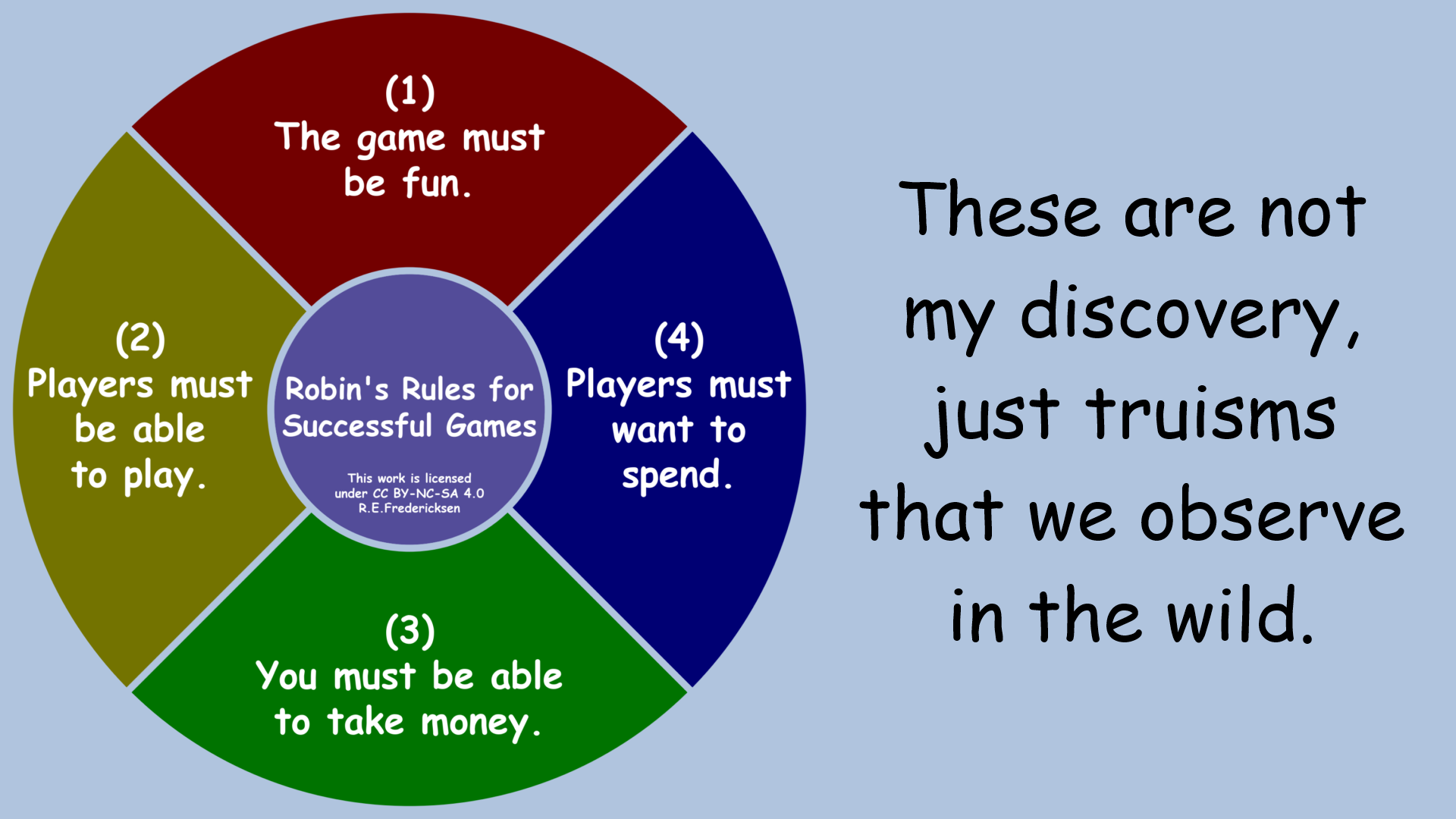
This is the name I used for them starting about 7 years ago as a way of joking seriously about what was important. I hesitated to call them "my rules" because it could sound egotistical. They are not my discovery, just truisms that I observed in the wild. Veterans of the industry must know them, and I am just calling them out.
On the other hand, alliteration helps us remember things, so what the heck.
These rules assume that you are making a game that is not free (zero expected revenue). If you are doing that, then you can stop after the first two rules.
The game MUST be fun.
Players MUST be able to play.
You MUST be able to take money.
Players must WANT to spend.
WHY THEY MATTER
Games cost a lot of money, time, and effort. Passion. Blood sweat and tears. People get lost in the morass of details and get blinded by passion for the things that matter most to them. Artists with art, designers with design, programmers with code. And investors with money.
These rules should be used as a reminder of what is important when deadlines are approaching and the team's time and resources can't meet all the demands.
DEEPER DIVE
Rule 1 - The game MUST be fun
OK. This one is so obvious that even trying to dive deeper seems silly. But there is still great mystery around how to make a fun game. Whole books have been written (e.g., Theory of Fun for Game Design). But what constitutes fun for a tabletop adventure may not apply to a 3P shooter, or an ARPG.
I know of a large game company with an entire department whose job is to play third party games they fund and provide feedback on what's fun, and what's not.
There are whole systems designed around creating and tweaking mobile games to keep you playing, focusing on injecting dopamine into your reward system pathways. That's why so many mobile games are essentially the same game, just reskinned with new art.
The point is that not only is this rule the most important rule, we don't seem to have great systems that are not just focusing on our human neurophysiological and psychological weaknesses.
But the ground truth is that, if your game is not fun, then no one will want to play. If no one wants to play then no one will want to spend.
And then you will be unable to fund your team.
Rule 2 - Players MUST be able to play
This one also covers a lot of ground. There are so many things that can block your players.
Maybe your game client is crashing, or the login servers are down, or the game servers are overloaded and leaving players with a laggy, slideshow mess.
Maybe there are progression bugs, or graphical glitches that occur at the very worst moment.
Maybe there are gameplay exploits being used in your competitive modes to tilt the playing field.
Maybe players have no idea your game exists. Mobile games have a serious discoverability issue, and getting seen on console stores is a whole thing.
These are just a few high friction things that make players not want to play, no matter how fun the game is.
See the comment above about funding the operation of your team.
Rule 3 - You MUST be able to take money
If there is no easy, cheap, reliable, and fraud resilient way to accept money, then either players won't play (because they must pay to download your game), or they will play and you will not have revenue to support the team. Or you'll get slammed with chargebacks.
Note that systems for monetary transactions are highly difficult to get correct and will need to function around the world with many currencies, including gift cards and other esoteric, country specific methods.
And not least, players around the world will try to find ways to cheat, get discounts, and exploit errors in the system. You will need fraud prevention practices as well as the ability to make bad transactions right again.
So, broken record time - if you can't take money, you can't fund your team.
Rule 4 - Players must WANT to spend
In the beginning I only had the first three rules, but then my friend Loic Claveau called attention to free-to-play (F2P) games. In the F2P world, even if the first three rules are met, players must still WANT to spend money.
The vast majority of F2P players pay nothing for your game. One statistic I have seen for mobile players recently says just over 2% of players 'convert' (pay anything). Another source said 5%. The statistics will vary by platform, genre, and game, but you will need to have things in the game that invite players to spend.
This time I'll just say it the short way: you need to fund your team!
INSUFFICIENCY
The math and engineering world has a lot of good terminology and phrases. One of those phrases is "necessary but not sufficient." A condition that is necessary is required for the math or engineering to work. Calling it not sufficient acknowledges that other conditions are also necessary.
There are scads of other tasks and issues at play in launching a successful game. Some of those fall outside of these four rules, but you can also unpack each of those into finer detail. There is not enough space to do that here, but you can find some of that in my series on the Iceberg Economics of Game Development. 🙂
OUTRO
Your team will inevitably face a deadline to ship (I pretend to not see you, Star Citizen). When that time comes your team needs good principles to follow when choosing where to spend your remaining precious time.
These rules are a reminder of what is important when time is getting tight and you have to choose which darling ideas, features, or game modes need to be delayed or ditched. Because including an unfinished, untested, or unfun feature is only going to hurt your game.